
Shopify email flows that drive revenue: the UK guide
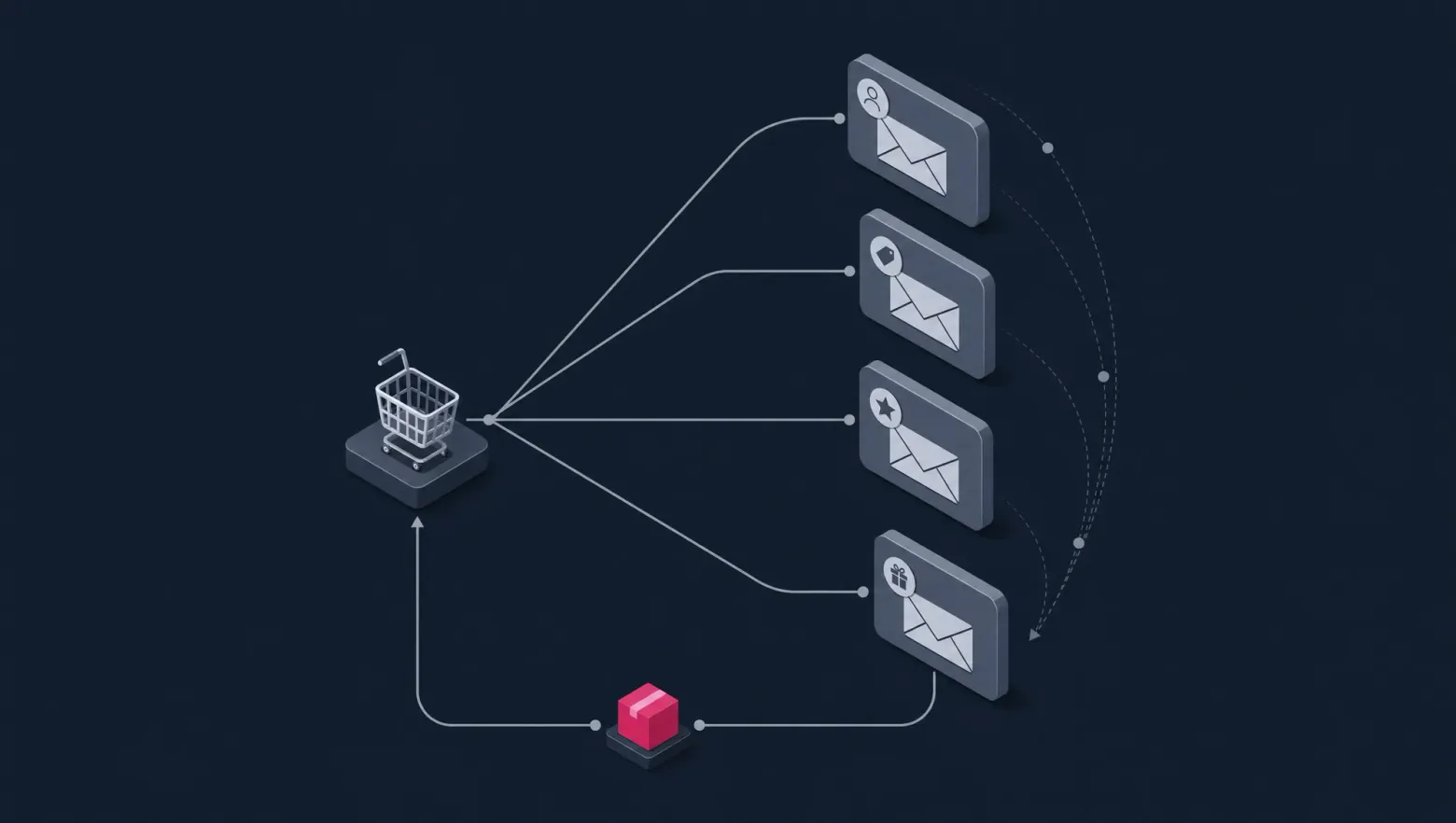
Email flows are automations that send the right message to one shopper at the moment they act: they join your list, abandon a basket, place an order or go quiet. They earn more than one-off campaigns because they reach people at peak intent. Klaviyo’s 2026 benchmarks show flows producing about 41% of email revenue from 5.3% of sends. For a UK Shopify store, four flows do most of that work, and PECR sets the rules.
What are email flows and why do they earn more than campaigns?
An email flow is an automation triggered by one person’s behaviour, so it sends only when that shopper does something specific. A campaign is a single message you broadcast to a list on a date you pick. The flow waits for intent; the campaign creates the moment itself.
That difference shows up in the revenue. In Klaviyo’s 2026 email benchmarks, dated 24 February 2026 and drawn from more than 183,000 brands, flows generated nearly 41% of total email revenue from just 5.3% of sends. Flow emails delivered a 5.58% click rate against 1.69% for campaigns, and a placed-order rate roughly 13 times higher. The reason is timing: a flow reaches a shopper while they are deciding, not when your calendar says it is newsletter day.
The number that makes the case. Klaviyo’s 2026 data shows automated flows earning about 41% of all email revenue from just 5.3% of sends. A small slice of well-timed, automatic emails does most of the work.
Campaigns still matter for launches, sales and seasonal pushes. Flows are the always-on layer underneath that earns while you sleep, and once built they need only periodic tuning rather than weekly production work. That is where email and lifecycle marketing earns its keep.
Which automated flows should a UK Shopify store set up first?
Start with four flows in this order: abandoned cart, welcome, post-purchase, then winback. Klaviyo’s own guidance names welcome series, abandoned cart, post-purchase and winback as the four flows to create first.
The abandoned-cart flow goes first because it reaches shoppers with the clearest intent: they chose a product and stopped at the till. That is the cheapest revenue to recover. The welcome flow comes next, because it converts the subscribers your sign-up form is already collecting. Post-purchase lifts the value of customers you have just won, and winback reaches for the ones drifting away.
The table below sets out the four foundational flows, their trigger and the benchmark figure that justifies building each one.
| Flow | Trigger event | Why it earns | Benchmark RPR |
|---|---|---|---|
| Abandoned cart | Added to cart or checkout started | Highest-intent shoppers, ready to buy | £2.85 ($3.65) |
| Welcome | Subscribed to a list | Converts new subscribers to a first order | £2.07 ($2.65) |
| Post-purchase | Placed an order | Lifts repeat-purchase rate | £0.32 ($0.41) |
| Winback | Time since last order | Reactivates lapsing customers | Set by basket value |
Figures are Klaviyo flow revenue-per-recipient averages from its abandoned cart benchmark report, based on flows sent in 2023, as of May 2024. Sterling shown at roughly £0.78 to the US dollar; treat as directional, since your own basket size and margin move these numbers.
How does the welcome flow turn a new subscriber into a first order?
The welcome flow greets a new subscriber while their interest is highest, the minutes after they hand over an email address. In Klaviyo it triggers on the “subscribed to list” event, fires within minutes, and runs as a short series rather than a single email.
A workable shape for a UK store is three messages. The first confirms the sign-up, sets out who you are and delivers any incentive you promised, such as a first-order discount. The second, a day later, tells your brand story and points to best-sellers. The third, two or three days on, adds social proof and a gentle nudge to buy. The welcome flow carries the highest revenue per recipient after abandoned cart in Klaviyo’s benchmarks, around £2.07 ($2.65), so the first message carries real weight.
Keep the incentive honest and the opt-out clear. The discount code lives in the welcome flow, not the sign-up confirmation alone, which keeps the marketing and the service message separate, a distinction PECR cares about and the legal section below explains.
What goes in an abandoned-cart flow that actually recovers baskets?
An abandoned-cart flow reminds a shopper of the exact items they left behind and gives them a frictionless path back to checkout. It should show the product image, name and price, link straight to the recovered basket, and reassure on the things that stall a UK buyer: delivery cost, returns and stock.
A three-email sequence works for most stores. Send the first reminder about an hour after abandonment, while the decision is fresh, with no discount, just the basket and a clear button. Send the second after a day, adding reassurance such as reviews or a delivery promise. Send the third after two to three days, and only here consider a modest incentive, because leading with a discount trains shoppers to abandon on purpose.
Klaviyo draws a useful line between two triggers. The “added to cart” event fires the abandoned cart flow as soon as someone drops an item in the basket, catching browsers who never reach checkout. The “checkout started” event fires later, once a shopper enters their email at checkout, capturing higher-intent visitors who got further. Many stores run both, with different copy for each level of intent. Across Klaviyo’s data, abandoned-cart flows averaged a 50.5% open rate, a 6.25% click rate and a 3.33% placed-order rate, the strongest of the foundational flows.
How does a post-purchase flow lift repeat-purchase rate?
A post-purchase flow turns a one-time buyer into a returning one by staying useful after the sale. It triggers on the “placed order” event and sends in the days and weeks after delivery, when goodwill is high and the product is fresh in the customer’s hands.
The sequence does three jobs. It thanks the customer and sets delivery expectations, which reduces “where is my order” support tickets. It then helps them get value from what they bought, with care tips, sizing notes or a how-to, so the product lands well. Finally, at the point a refill or complementary item makes sense, it suggests the next purchase. Post-purchase flows carry a lower revenue per recipient than abandoned cart, around £0.32 ($0.41) on Klaviyo’s averages, because they are about retention over time rather than rescuing a single sale.
Repeat buyers compound. A flow that earns a second order also feeds your winback and replenishment timing, because it teaches you the average gap between purchases for your range.
When should you send a winback flow, and what should it say?
Send a winback flow when a customer has clearly lapsed but is not yet gone, which Klaviyo frames as roughly 1.5 times your average gap between orders. If your shoppers reorder every 50 days, start the winback flow around day 75, not at six months when they have forgotten you.
Pull the timing from your own Shopify data rather than guessing. Export orders, sequence them by customer, and calculate the median gap between first and second purchase; that figure sets your trigger. The message should acknowledge the absence plainly, remind them what they liked, and give a reason to return: a new range, a restock or, as a last step, an incentive.
Keep it to three emails and know when to stop. A light first touch, a stronger second with social proof, and a final message with an offer is enough. If they still do not engage, move them to a sunset segment rather than emailing someone who will never buy again, which protects your deliverability and your sender reputation.
How do you connect these flows to Shopify with Klaviyo?
Connect Klaviyo to Shopify through the native integration, which syncs the events your flows trigger on. In Klaviyo, go to Integrations, search for Shopify, add the integration and authorise it from your Shopify admin. Once connected, Shopify events such as added to cart, checkout started, placed order and viewed product become available as flow triggers.
Two setup steps matter for cart recovery. Enable the Klaviyo app embed in your theme and switch on behavioural event tracking, or the “added to cart” trigger will not fire. Then turn off Shopify’s own abandoned checkout email if you run a Klaviyo abandoned-cart flow, or customers receive duplicate reminders. Build each flow from Klaviyo’s flow library, which provides pre-made skeletons with the right filters, then edit the copy and timing to suit your store.
This is product and email-data hygiene, not engineering, and it is the same discipline that makes your store legible to AI shopping agents. For that wider shift, see our guide on agentic commerce for UK Shopify stores.
What open, click and revenue benchmarks should you expect?
Expect flow emails to outperform broadcast campaigns on every engagement measure, because they reach people at the moment of intent. Klaviyo’s 2026 figures put the average flow click rate at 5.58% against 1.69% for campaigns, with a placed-order rate roughly 13 times higher.
Set those flow numbers against a campaign baseline. Retail email campaigns average about a 37.47% open rate and a 1.27% click rate, on MailerLite’s 2026 industry benchmarks drawn from over 3.6 million campaigns. Read open rates with caution: Apple’s Mail Privacy Protection inflates reported opens by pre-loading images, so click rate and placed-order rate are the more honest signals. Use the per-flow averages in this guide as a starting line, not a target, then measure against your own first 90 days of data.
How do PECR and UK GDPR affect what you can automate?
The Privacy and Electronic Communications Regulations (PECR) govern marketing email to UK individuals, and regulation 22 sets the consent rule. You may not send marketing email to an individual unless they have specifically consented, with one exception that matters for Shopify stores: the soft opt-in.
The ICO’s electronic mail marketing guidance sets three conditions for the soft opt-in, and you need all three:
- You obtained the contact details in the course of a sale or negotiations for a sale of a product or service.
- You market only your own similar products or services.
- You gave a simple way to opt out when you collected the details, and in every message since.
So you can usually email existing customers about similar products under the soft opt-in, while cold prospects and bought-in lists need real consent. UK GDPR sits alongside PECR, requiring that any consent you do rely on is freely given, specific and unambiguous, and that your sign-up forms are not pre-ticked. The lawful side of a flow is mostly built at the sign-up form, so get the wording and the opt-out right there. Getting this wrong is not hypothetical: the ICO fines firms for unlawful marketing email, as our guide on the UK data-complaints duty and PECR fines sets out.
Can a Shopify order confirmation carry marketing?
Keep order confirmations clean, because the ICO treats them as service messages that lose their exemption the moment they sell something. A routine confirmation, providing information about a current order such as what was bought and when it ships, is not direct marketing and needs no marketing consent.
Add a discount on the next order, a cross-sell or a “save money by signing up” line, and the ICO’s direct marketing guidance says that any direct-marketing element, even when marketing is not the message’s main purpose, turns the whole message into direct marketing, which then needs a lawful basis under PECR. Only general branding, such as a logo or strapline, stays exempt. The safe pattern is to keep the receipt purely transactional and put any promotion in a separate post-purchase flow that runs on marketing consent. This matters more as sales move into AI surfaces, where the same UK rules follow your products; our guide on getting cited in Google AI Mode and AI Overviews covers that discovery shift.
How do you measure whether your flows are working?
Measure each flow on revenue per recipient and placed-order rate first, then click rate, and treat open rate as a soft signal because Apple’s Mail Privacy Protection inflates it. Revenue per recipient tells you what one more subscriber through the flow is worth; placed-order rate tells you how often it converts.
Track three things over your first quarter:
- Share of email revenue from flows. Klaviyo’s 2026 data shows flows at about 41% of email revenue, so a healthy store sees flows carrying a large slice without you sending more.
- Per-flow revenue per recipient, compared against the benchmarks above, to find the weakest flow and fix its copy or timing.
- Unsubscribe and spam-complaint rate, which protect deliverability; rising complaints usually mean your timing or frequency is wrong.
Review monthly, change one variable at a time, and let each flow gather a few hundred recipients before you judge it. Small, evidenced edits to timing, subject lines and the first email beat wholesale rebuilds.
Where to start
If you run a UK Shopify store, build the abandoned-cart flow first, connect Klaviyo to sync your cart and checkout events, and confirm your sign-up form meets the soft opt-in before you send a thing. That one flow, done properly, recovers more revenue than any campaign you could schedule this month.
Where to start
If you would rather have the flows built, the triggers wired to Shopify correctly and the consent and order-email wording checked against PECR, we will set up the four foundational flows, connect them to your store and make sure your automation is on the right side of UK marketing rules.
Frequently asked questions
What is the difference between an email flow and an email campaign?
A campaign is a one-off send you push to a list on a date you choose, such as a sale announcement. A flow is an automation that fires for one person when they do something, such as abandon a basket or place a first order. Flows run continuously without you touching them, which is why they earn far more revenue per recipient than campaigns.
Which Shopify email flow should I build first?
Build the abandoned-cart flow first. It targets shoppers with the clearest intent, people who chose a product and stopped short of paying, so it recovers the most revenue for the least effort. Klaviyo names welcome series, abandoned cart, post-purchase and winback as the four flows to create first.
Is Shopify's built-in abandoned cart email free?
Yes. Shopify's abandoned checkout automation is built into Shopify Email and sends a reminder for free, and those sends do not count against your monthly email allowance. It only fires after a shopper starts checkout, so it misses people who add to a basket and leave before checkout. A Klaviyo abandoned-cart flow can trigger on the earlier add-to-cart event.
Can my Shopify order confirmation include a discount or product promotion?
Be careful. The ICO treats order confirmations as service messages that do not need marketing consent, but they must stay purely informational. Adding any direct-marketing element, such as a discount on your next order or a cross-sell, turns the message into direct marketing, which then needs a lawful basis under PECR. Keep the receipt clean and put promotions in a separate consented flow.
Do I need consent to send marketing emails to UK customers?
Usually yes, but there is an exception. Under PECR you need specific consent to email individuals, unless the soft opt-in applies: you got their details during a sale or negotiation for a sale, you only market your own similar products, and you gave a clear opt-out at sign-up and in every message. Existing customers can often be emailed under that exception; cold prospects cannot.
- Email marketing benchmarks 2026: open, click and conversion rates
- Abandoned cart benchmark report: rates and statistics
- How to create an abandoned cart flow
- Getting started with flows
- How to create a winback flow
- Shopify Messaging email pricing
- Opt in to the new abandoned checkout automation
- Electronic mail marketing (PECR regulation 22)
- Identify direct marketing (service messages and marketing)
- Email marketing benchmarks 2026: average open and click rates
Related reading
The total cost of running a Shopify store in the UK
What a UK Shopify store really costs each month in 2026: plan fees, card rates, the third-party transaction fee, apps, and a worked example to copy.
11 August 2026 7 min read
Shopify Thank you page upgrade: what stops on 26 August
Shopify's Thank you and Order status pages must be upgraded by 26 August 2026. What stops running, what replaces it, and how to migrate in time.
9 August 2026 5 min read
Shopify Thank you page migration: the full checklist
A step-by-step playbook for Shopify's Thank you and Order status page upgrade: audit additional scripts, map replacements, test, publish, verify the data.
9 August 2026 5 min read