

Agentic commerce for a UK Shopify store, explained
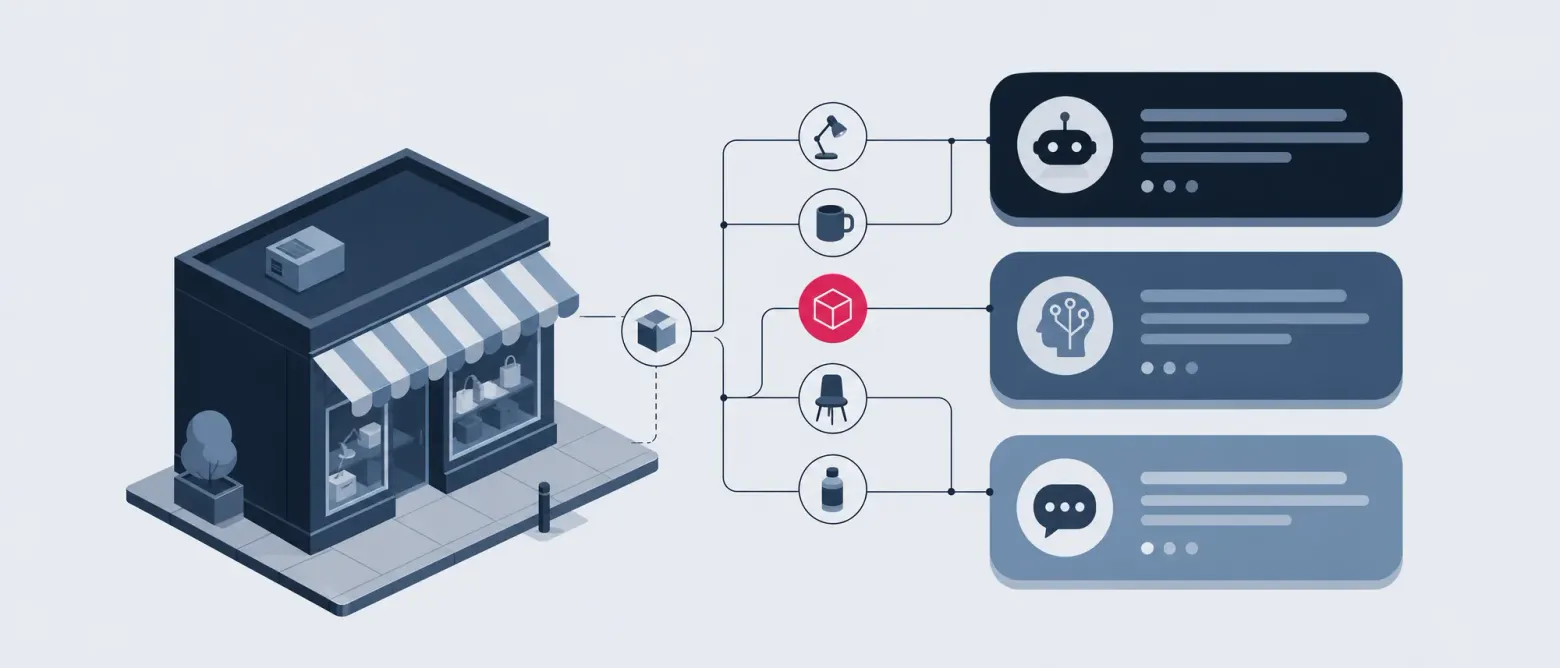
Agentic commerce is shopping done by an AI assistant on a person’s behalf: they ask ChatGPT, Copilot, Gemini or Google AI Mode for a product, and the assistant finds it, compares options and can buy it inside the chat. For a UK Shopify store it means a second storefront you do not design – your product data, read by machines. The work is data hygiene, not a rebuild, with one consumer-rights caveat on in-chat checkout.
What is agentic commerce, in plain terms?
Agentic commerce is when an AI agent completes shopping tasks for a person – search, comparison and, increasingly, the purchase – rather than the person browsing your site. The shopper describes what they want in natural language; the agent queries a structured product dataset, ranks the matches, and either links out or buys without leaving the conversation.
For a Shopify merchant, the practical shift is who reads your catalogue. A human reads your theme, your photography and your copy. An agent reads structured fields: title, price, availability, variants, attributes and reviews. If those fields are wrong, thin or missing, the agent either skips your product or describes it badly. Your storefront design still matters for people who click through, but it is no longer the only thing standing between a customer and a sale.
How did Shopify get here? A short timeline
The current state did not arrive in one launch. It matured across three Shopify Editions over six months, which is worth knowing because each step changed what you have to do.
The three milestones, with the primary source and what each changed for merchants. The Agentic Storefronts release in the Winter ’26 Edition (10 December 2025) let merchants toggle which AI surfaces show their products, with attribution flowing back into Shopify admin. The Universal Commerce Protocol was then set out by Shopify and Google on 11 January 2026, in Shopify’s engineering blog and Google’s developer blog, with early backers including Etsy, Target, Walmart and Wayfair – an open standard for how AI agents discover and transact with merchants. The Spring ’26 Edition (17 June 2026) enabled UCP by default and opened the Catalog API to any developer with an API key, no approval needed. That June step is the one that opened the door to every store, so it reads like a launch. It is better understood as the point at which earlier groundwork became generally available.
How do my products get into ChatGPT, Copilot and Gemini?
Through Shopify Catalog, which Shopify describes as “the search infrastructure for shopping: a global, structured dataset that agents can search and understand.” Eligible products are included automatically, and that catalogue syndicates out to AI surfaces without extra apps.
In the Spring ’26 merchant edition, Shopify states that products now surface across ChatGPT, Copilot, AI Mode in Google Search, the Gemini app and Shop, with performance visible in the admin. The mechanism is syndication, not a feed you build by hand: if your product meets the eligibility bar and your data is clean, it can appear in an agent’s answer.
Shopify also makes a conversion claim worth holding lightly because it is the platform’s own figure: “AI searches powered by Shopify Catalog convert at 2x the rate of those using scraped data,” per the Spring ’26 developer edition. Treat that as a directional signal that structured data beats scraped data, rather than a guaranteed result for your shop.
What does the free agentic-readiness scanner actually test?
It tests technical readiness only – the structured data on a product page – and nothing about whether shoppers will choose you. Shopify’s free agentic commerce audit checks “your product page for the structured data that AI agents read to answer shoppers’ questions.”
That scope is the important part. The tool’s own disclaimer is explicit: these “are informational signals for your product page that AI agents may use to discover, evaluate, and recommend your products, but do not guarantee your products will be surfaced.” It does not score your reviews, your price competitiveness or your returns policy. So a clean scan means an agent can read you, not that an agent will pick you. Reviews, price and post-sale terms still decide whether you win the recommendation.
A note on the “31 checks” figure you may have seen: that count comes from third-party analyses of the tool, not from Shopify itself. Use the scanner for what it is – a quick technical gap check – and do not treat any single number as an official benchmark.
What is the real job: product-data hygiene
The real work is agentic-commerce product-data hygiene: making every field an agent reads accurate, complete and consistent. This is unglamorous and it is where the wins are. An agent cannot infer that your “navy” jumper is the same as a shopper’s “dark blue” request, or that a product is in stock, unless your data says so cleanly.
A practical order of work for a UK store:
- Titles and descriptions – write them for a person who cannot see the page, with the material, use and key attributes in plain words.
- Variants and attributes – fill colour, size, material and any spec fields; agents match on these, not on your photos.
- Price and availability – keep them accurate in real time, including VAT-inclusive pricing for UK shoppers (covered below).
- Reviews – genuine, recent reviews are a ranking and trust signal the scanner does not test but agents use.
- Returns and delivery – clear, machine-readable terms reduce the friction that loses an in-chat sale.
None of this requires a new theme or a developer. It requires the same discipline a good product feed has always needed, applied because a machine is now the first reader.
What UK consumer law applies when checkout happens inside an AI chat?
The same law that applies to any UK distance sale applies inside an AI chat: a sale to a UK consumer through an agent is still a distance contract, so the Consumer Contracts Regulations 2013 and the right to clear pre-contract information both apply, wherever the “buy” button sits.
Three obligations matter most when a purchase can complete without the shopper ever loading your site:
- Pre-contract information. GOV.UK’s distance selling guidance requires you to give the customer, before they order, your business details, a description of the goods, “the price, including all taxes”, delivery costs and timing, and how to cancel. If an agent is presenting your product, that information has to reach the shopper through it.
- VAT-inclusive prices. The price shown to a UK consumer must include all taxes. If your Catalog data carries a VAT-inclusive price, the agent can present the right figure; if it does not, you risk a misleading price in someone else’s interface.
- The 14-day cancellation right. Under the Consumer Contracts Regulations 2013, a UK consumer buying at a distance has 14 days to cancel without giving a reason. GOV.UK is blunt about the cost of silence: if you fail to tell the customer about the cancellation right, it extends to 12 months.
The caveat for agentic checkout is that you may not control the interface where the sale closes, but you remain the trader, so the duty to surface this information correctly is still yours. Build it into your product data and terms now, rather than assuming the AI surface handles it.
How big is this for UK stores today?
Large enough to act on, small enough to do calmly. The discovery shift is already measurable: Google AI Overviews appeared on 14.0% of shopping queries by March 2026, up 5.6× from 2.1% in November 2025, according to Visibility Labs analysis reported by Search Engine Land across 20.9 million shopping keywords.
One honest UK caveat: in-chat checkout on Google’s surfaces launched for US shoppers first. For UK stores the immediate change is discovery and citation – being read, ranked and recommended by agents – with in-AI purchase arriving on a longer timeline. That is good news for sequencing: you can fix your data for discovery now, and the work you do is the same work that pays off when in-chat checkout reaches the UK.
The UK position today. Your products can already be found, cited and recommended by AI agents; in-chat checkout reached the US first. The data work that earns a recommendation now is the same work that supports checkout when it lands in the UK.
A practical checklist for UK Shopify owners
Work through these in order. None needs a redesign, and the first step is Shopify’s free agentic-readiness audit.
UK Shopify agentic-readiness checklist
Where to start
If you run a UK Shopify store, the first move is small and free: run the readiness audit, then spend an afternoon on the product data behind your best sellers. That single pass does more for agentic visibility than any redesign.
Where to start
If you would rather have the data work done properly and checked against UK consumer-rights rules, we will run the audit, fix the fields that matter and make sure your pricing and cancellation information are right for in-chat selling.
For the wider news context, see our coverage of the Spring ’26 Edition opening UCP and the Catalog API to every store and what Shopify’s free readiness scanner really tests.
Frequently asked questions
Do I need to do anything technical to appear in AI chat?
For most stores, no rebuild is needed. Eligible products are included in Shopify Catalog automatically and syndicate to surfaces like ChatGPT, Copilot, Gemini and Google AI Mode. The work is data quality – accurate titles, attributes, prices and availability – not engineering. Run Shopify's free readiness audit to find technical gaps, then fix the product data behind them.
Does a clean readiness scan mean I will win the sale?
No. The readiness scanner tests technical readiness only – whether agents can read your structured data. It does not score reviews, price or returns, and its own disclaimer says a clean result does not guarantee your products will be surfaced. Treat it as a gap check, then compete on the things shoppers and agents actually weigh: genuine reviews, fair pricing and clear terms.
Can customers buy from my UK store inside an AI chat right now?
Discovery and recommendation across AI surfaces are live for UK stores; in-chat checkout on Google's surfaces launched for US shoppers first. So today the UK change is being found, cited and recommended by agents, with in-AI purchase arriving later. The right move is to fix product data for discovery now, because the same work supports checkout when it reaches the UK.
Does UK consumer law still apply if the sale happens in ChatGPT?
Yes. A sale to a UK consumer through an AI agent is a distance contract, so the Consumer Contracts Regulations 2013 apply. You must give pre-contract information including the price with all taxes, and the shopper keeps a 14-day right to cancel. You remain the trader even when you do not own the interface, so make sure that information travels with your product data.
Is agentic commerce the same as SEO?
They overlap but are not the same. Classic SEO optimises pages for human clicks from search results; agentic commerce optimises structured product data so machines can read, compare and recommend you inside a conversation. Both reward accurate, well-described products. If you want the search side in depth, see our guide on getting cited in Google AI Mode and AI Overviews.
- Shopify Spring '26 Edition (merchant)
- Shopify Spring '26 Edition (developer)
- Winter '26 Edition: agentic storefronts
- Under the hood: the Universal Commerce Protocol
- Agentic commerce audit (readiness scanner)
- Google AI Overviews now appear on 14% of shopping queries
- Online and distance selling for businesses
- The Consumer Contracts (Information, Cancellation and Additional Charges) Regulations 2013
Related reading
Google's new rule on review-for-discount schemes
Google now bars undisclosed incentivised reviews from review markup. What a UK store running a review-for-discount offer stands to lose, and the fix.
11 August 2026 6 min read
The total cost of running a Shopify store in the UK
What a UK Shopify store really costs each month in 2026: plan fees, card rates, the third-party transaction fee, apps, and a worked example to copy.
11 August 2026 7 min read

Shopify Thank you page upgrade: what stops on 26 August
Shopify's Thank you and Order status pages must be upgraded by 26 August 2026. What stops running, what replaces it, and how to migrate in time.
9 August 2026 5 min read