

Google's new rule on review-for-discount schemes
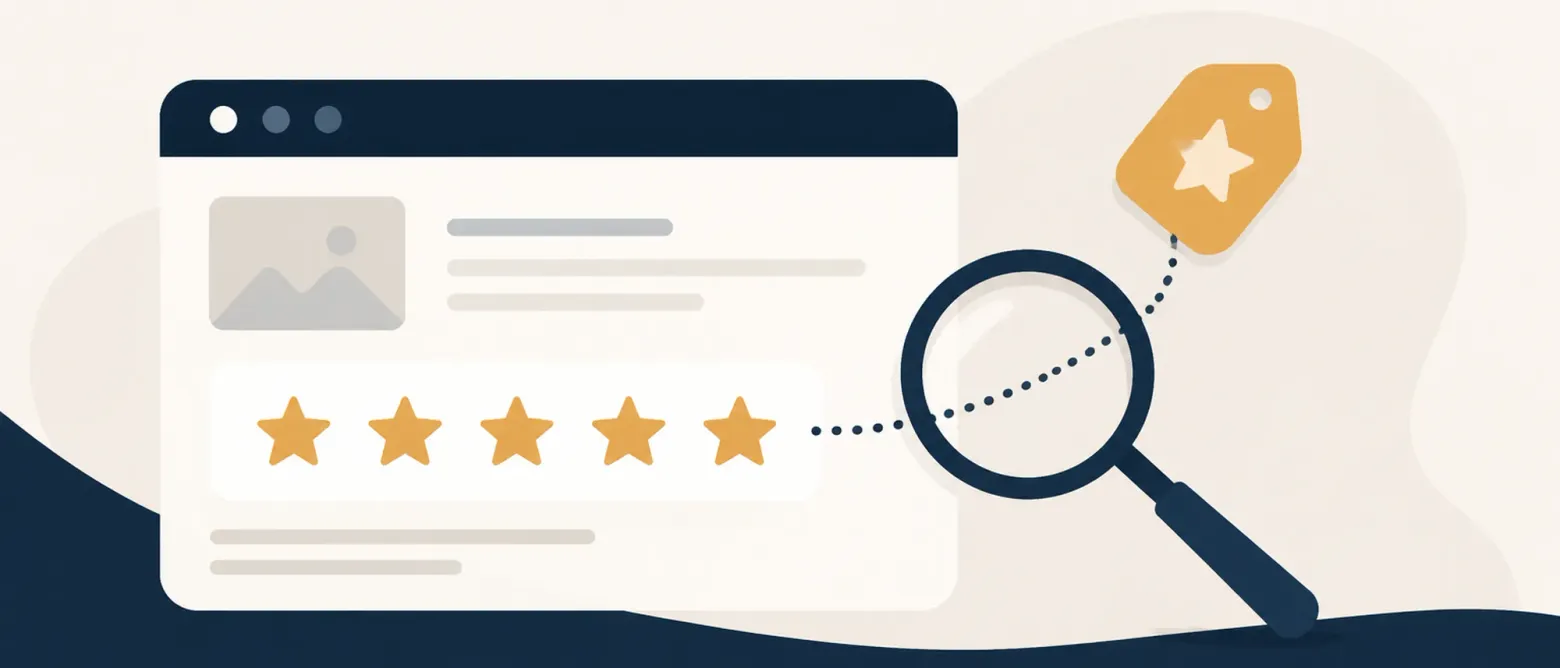
On 24 July 2026 Google added a guideline to its review snippet documentation: do not include fake or undisclosed incentivised reviews on a page or in its markup. A review snippet is the star rating and excerpt Google can show under a search listing. A UK store that offers a discount for reviews without disclosing the incentive, and feeds them into its product markup, is now in breach.
This piece is for UK Shopify merchants who collect product reviews and show star ratings in Google results — especially any store running a leave-a-review-get-money-off offer.
What did Google change on 24 July?
Google's review snippet guidelines now cover two kinds of review, recorded in the Search documentation updates log on 24 July 2026:
- Fake reviews — reviews not based on a genuine experience of the product or business.
- Undisclosed incentivised reviews — reviews written in exchange for money, a discount, a voucher or a free product, where the incentive is not clearly and prominently disclosed.
Neither belongs on the page or in the structured data. That second category is the one that catches ordinary, well-meaning stores. Much of the public discussion of review manipulation concerns Google Business Profile and Maps; this guideline is about the Review and AggregateRating markup on your own product pages — the code, usually app-generated, that earns the stars under your listings.
Is a leave-a-review-get-10%-off offer against the rules?
The offer itself is not what the guideline targets — the undisclosed use of its output is. The dividing line is disclosure:
| Your review practice | Status under Google's review snippet guidelines |
|---|---|
| Reviews from genuine purchases, no incentive | Fine to include on the page and in markup |
| Incentivised reviews, incentive clearly and prominently disclosed | Not caught by the wording, which bans the undisclosed case |
| Incentivised reviews, no disclosure | In breach — keep them off the page and out of the markup |
| Purchased, swapped or fabricated reviews | In breach — not based on genuine experience |
The uncomfortable part for Shopify stores is where those reviews come from. Post-purchase emails offering a discount code for a review are a feature several review apps offer, and the reviews they collect can flow straight into the same app's structured data. Nothing in that pipeline discloses anything unless you set it up to.
The catch in one line. Where one app both runs your discount-for-review campaign and writes your review markup, an undisclosed incentive can reach the structured data without anyone deciding that it should. Check whether that is true of your store.
What does a store lose, and how would it show?
What Google's documentation describes is eligibility for review rich results: the star rating, review count and snippet under your product listings. Structured data that violates the guidelines can stop earning that treatment; the page itself remains in ordinary search results.
Google's documentation says review rich results may be shown when it finds valid markup, and its structured-data guidelines govern eligibility — so the consequence to plan for is losing that eligibility, not a stated penalty. What that costs you depends on how much of your traffic arrives on listings that currently show stars — the same organic visibility this year's Google AI changes already put under pressure. Google does not say how it detects undisclosed incentives, and we will not guess; the honest framing is that the rule now exists, the penalty is defined, and compliance is cheap next to the exposure.
How does this sit with UK law?
Google's guideline is a search-eligibility rule, not the law — but UK law already points the same way. Under the Digital Markets, Competition and Consumers Act 2024, fake reviews and reviews that conceal an incentive are banned commercial practices, enforced by the Competition and Markets Authority. That is a separate regime with its own consequences, and nothing in Google's documentation changes it. The practical takeaway is that clear, prominent disclosure of review incentives is now the standard on both fronts, and an undisclosed scheme carries two distinct risks rather than one.
What should a UK Shopify store do now?
Audit the pipeline from incentive to markup, then either disclose or exclude:
- List every incentive you offer for reviews — post-purchase discount codes, loyalty points, entry into a draw, free products. Include anything a past agency or app set up that still runs.
- Find out which reviews it produced. Ask whether your review app records an incentivised flag per review. If nobody can say which reviews were incentivised, treat the scheme's output as undisclosed until proven otherwise.
- Choose disclosure or exclusion. Either show the incentive clearly and prominently where the review appears, or keep incentivised reviews off the page and out of the structured data. An unlabelled ten-percent-off review sitting in your AggregateRating is the exact case the guideline names.
- Check what your markup actually says. Run a product page through Google's Rich Results Test and look at the Review and AggregateRating output your theme and apps emit — most merchants have never read it.
- Fix the mechanism, not this month's reviews. If the collection flow cannot disclose, change the flow; a one-off cleanup that leaves the same pipeline running rebuilds the problem with next month's orders.
Review collection, disclosure and markup are one system, and they sit inside the wider job of reviews and reputation done properly — genuine reviews, honestly labelled, working for you in search rather than against you.
Keep the stars you have earned
If the review app in question is also the one writing your product markup, the wider job is the same discipline as getting your store ready for AI answers: the structured data has to say something you could defend.
True Noise is a UK digital agency in Peterborough working with small UK businesses. If your store runs a review incentive and nobody has looked at the markup it feeds, that is worth checking against the eligibility risk.
Keep the stars you have earned
We will audit your review collection flow and structured data, and make the disclosure or exclusion changes before the stars go missing.
Frequently asked questions
Can I still offer a discount for leaving a review?
Offering an incentive is not what the guideline bans. What breaches Google's review snippet guidelines is including a review written for money, a discount, a voucher or a free product on your page or in your structured data without the incentive being clearly and prominently disclosed. Disclose the incentive where the review appears, or keep those reviews out of your markup.
What does my store actually lose if it breaks the rule?
Eligibility for review rich results — the star ratings and review excerpts Google can show under your product listings in search. Structured data that violates the guidelines does not make a page ineligible for ordinary search results, but losing the stars on a product listing is a visible click-through hit. Google does not say how it detects violations, so treat the rule as one to comply with rather than one to gamble on.
Does my Shopify review app handle this for me?
Do not assume so. Review apps typically inject the Product, Review and AggregateRating markup automatically, and many also run the incentive campaigns that collect the reviews. Check whether your app records which reviews were incentivised, whether a disclosure shows where the review is displayed, and whether you can exclude incentivised reviews from the markup it emits. If the app cannot tell you which reviews were incentivised, that is the gap to close first.
Is this the same as the UK's fake-review law?
No. Google's guideline is a search-eligibility rule: markup that breaks it can stop earning review rich results. Separately, UK consumer law under the Digital Markets, Competition and Consumers Act 2024 treats fake reviews and concealed incentivised reviews as banned commercial practices, enforced by the Competition and Markets Authority. Complying with the disclosure rule serves both, but they are different regimes with different consequences.
Related reading
Shopify's free agentic-readiness scanner: what it tests
Shopify's free agentic-readiness scanner at shopify.com/agentic-readiness tests technical structured data only. What its checks cover, and what they don't.
24 June 2026 4 min read
Google AI Mode and AI Overviews: the UK Shopify job now
Google AI Overviews now hit 14% of shopping queries and AI Mode has been live in the UK since July 2025. What UK Shopify stores must do to stay discoverable.
23 June 2026 4 min read

Shopify Spring '26: UCP and Catalog open to every store
Shopify's Spring '26 Edition opens UCP and the Catalog API to every store, putting your products inside AI chat. What it means for UK shops.
21 June 2026 4 min read